Phil Burbank–Bronco Henry: Admiration and Remembrance
The Power of the Dog (Thomas Savage Edition)Phil Burbank’s bond with Bronco Henry shapes both his idea of the cowboy and the private history beneath his hard, combative manner. Bronco is at once mentor, remembered ideal, and a person Phil may have loved; his early death leaves Phil with an attachment that neither time nor the performance of conventional ranch masculinity can displace. The novel lets that significance emerge gradually, through Phil’s braiding, his stories, and a late disclosure about what he lost.
Mentor and Ideal
Bronco Henry is remembered as the ideal cowboy of Phil’s youth, a figure whose stature in Phil’s life exceeds the few times he is mentioned. He taught Phil, and Phil continues to measure cowboy skill and character against what Bronco passed on. The surviving evidence does not catalogue every lesson, but it makes the act of transmission central: Phil thinks of character as something woven from strands and regards braiding as an homage to the men who taught him. Bronco belongs to that lineage of makers and teachers, not merely to Phil’s recollections of the past.
That ideal is practical as well as emotional. Phil’s rawhide work demands time, skill, and attention; he values making a rope well and regards the craft as a form of knowledge that can be handed from one person to another. When he braids, he remembers Bronco among those whose example formed his hands and judgment. The craft therefore gives remembrance a material form: Phil does not simply tell himself that Bronco mattered; he repeats an activity through which their connection can be felt and continued.
Stories Passed On
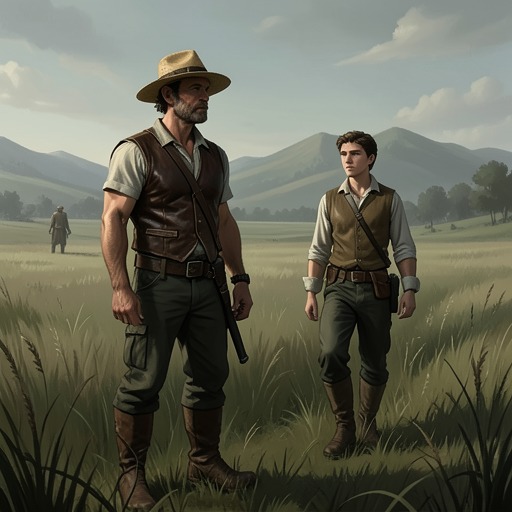
Phil also preserves Bronco by telling stories about him. During the fall, as he works with Peter Gordon, Phil recounts Bronco’s exploits, allowing the dead mentor to enter the younger boy’s imagination through spoken memory. Phil has taught Peter to ride and lent him a gentle bay horse; they ride into the fields, build pole fences around haystacks, and eat deviled-ham sandwiches and apples at noon while Phil talks about Bronco. These ordinary shared routines give the stories a setting in which instruction and companionship travel together.
The stories matter to Phil as much as they do to their listener. He takes pleasure in Peter’s attention and in the boy’s absorption in the old days. The scene makes memory an active relationship: Phil remains Bronco’s pupil in his own mind while becoming a teacher who carries Bronco’s example forward. His promise to finish Peter’s rope before the boy returns to school gives this transmission a concrete object. The rope is not simply a demonstration of skill; it joins Phil’s remembered apprenticeship to a new, developing bond.
Loss and Private Attachment
Late in the novel, the history behind Phil’s devotion becomes clearer. Bronco died in an accident in the corral while Phil, then twenty years old, watched from the top rail. The loss was not only that of a mentor. The narration reveals that Phil had wanted to touch Bronco and may have loved him, leaving the precise nature of their past emotionally clear but not exhaustively defined. This disclosure recasts the intensity of Phil’s remembrance: Bronco has remained unmatched because Phil’s attachment to him was personal as well as admiring.
The death also helps explain why Phil treats intimacy as something dangerous to approach again. In a later scene, when Peter offers rawhide strips he has cut himself because he wants to learn braiding, Phil understands the gesture as an effort to emulate and join him. The narration connects Phil’s response to the earlier loss of Bronco and to an old vow, made in loyalty to Bronco, not to repeat a certain intimate gesture. Phil nevertheless puts an arm around Peter’s shoulders and welcomes the boy’s offer. The moment does not erase the past; it shows how Bronco’s memory has become part of Phil’s hesitant response to a new attachment.
Legacy and Meaning
Phil’s bond with Bronco also illuminates the contradiction in Phil’s public identity. He cultivates a rough, emphatically masculine image and is hostile toward men he considers insufficiently masculine. The novel links this performance to Phil’s awareness of his own same-sex desire and to the condemnation he anticipates in the cowboy world around him. Bronco’s death alone does not account for Phil’s cruelty, but the concealed attachment helps explain why he has made hardness such a deliberate defense. His remembered loyalty and his outward scorn coexist; one does not cancel the other.
Bronco’s influence consequently reaches beyond nostalgia for an earlier ranching life. It shapes Phil’s skills, his stories, his private understanding of himself, and his capacity—however guarded—to recognize a bond with Peter. The late revelation that Bronco was both Phil’s model and the object of a profound attachment changes the meaning of the work and mentorship that preceded it. Phil keeps Bronco present by braiding and remembering, even as the loss that binds them limits what Phil believes he can safely feel again.